Thursday, 3 December 2015

Innovation is vital for combating climate change & ensuring climate justice: PM at Mission Innovation event hosted by the US President

President Hollande, President Obama, Excellencies, Mr. Bill Gates, Distinguished Guests, 
Let me begin by saluting President Hollande and the people of France for their courage and resolve; and, to the world for coming together for Paris and France. 

The outstanding arrangements reflect the character of this great nation. The world has assembled in Paris to change the course of our planet to a sustainable path. 

We must speak about goals and targets on carbon emissions and rise in global temperature. But, it is just as important to focus on the instruments that will make it natural and easy for the world to get there.
Innovation is vital for combating climate change & ensuring climate justice: PM at Mission Innovation event hosted by the US President COP-21 Summit, International, Speeches, Mission Innovation, Barack Obama, USA
A vast section of humanity lives at the edge of poverty and in darkness after the sun sets. They need energy to light up their homes and power their future. 

And, they are also the most vulnerable to the consequences of an industrial age powered by fossil fuel. 

Access to energy and a better life is a universal aspiration. And, so are clean environment and healthy habitats. 

As the world's majority works its way to prosperity on a planet left with very limited carbon space , we have to do many things. 

We have to ensure, in the spirit of climate justice, that the life of a few does not crowd out the opportunities for the many still on the initial steps of the development ladder.
Innovation is vital for combating climate change & ensuring climate justice: PM at Mission Innovation event hosted by the US President COP-21 Summit, International, Speeches, Mission Innovation, Barack Obama, USA
The advanced countries must leave enough room for developing countries to grow. And, we must strive for a lighter carbon footprint on our growth path. 

For that we must come together in a partnership to bring clean energy within the reach of all. 

Innovation is vital for combating climate change and ensuring climate justice.
Innovation is vital for combating climate change & ensuring climate justice: PM at Mission Innovation event hosted by the US President COP-21 Summit, International, Speeches, Mission Innovation, Barack Obama, USA
That is what makes this Innovation Summit very special. This unites us behind a common purpose. 

We need research and innovation to make renewable energy much cheaper; more reliable; and, easier to connect to transmission grids. 

We can make conventional energy cleaner. And, we can develop newer sources of renewable energy. 

This is a global responsibility to our collective future. 

Our innovation initiative should be driven by public purpose, not just market incentives, including on intellectual property.
Innovation is vital for combating climate change & ensuring climate justice: PM at Mission Innovation event hosted by the US President COP-21 Summit, International, Speeches, Mission Innovation, Barack Obama, USA
That also means strong public commitment by suppliers to developing countries. 

That will make clean energy technology available, accessible and affordable for all. 

This partnership will combine the responsibility of governments with the innovative capacity of the private sector. We will double our investments in research and innovation; and, deepen collaboration among ourselves. 

We should have an international network of 30-40 universities and labs focusing for next ten years on renewable energy. 

Innovation must be backed by means to make it affordable and ensure adoption.
Innovation is vital for combating climate change & ensuring climate justice: PM at Mission Innovation event hosted by the US President COP-21 Summit, International, Speeches, Mission Innovation, Barack Obama, USA
We have a very successful models of public-private partnership with many countries present here. India is also building renewable capacity in developing countries, including small island states. 

The progress on clean energy technology and costs is impressive. If we raise the level of our efforts, we can transform the world. 

We will also lay the foundation of a new economy in new low carbon age. 

We will restore the balance between ecology and economy, and between our inheritance and obligation to the future. And, live up to Gandhiji's call to care for the world we shall not see. 

Saturday, 28 November 2015

Fulfilling Pandit Deendayal Upadhyaya ji’s dream of a developed and just India

Dear Friends,
Today we bow to Pandit Deendayal Upadhyaya ji, on his birth anniversary. This year the occasion is even more special as it marks the beginning of Deendayal ji’s centenary year.
Pandit Deendayal Upadhyaya is our inspiration. From his life we learn how an individual completely devoted himself to the wellbeing of the nation and the service of the poor. As a political organiser, his work was legendary. Without getting trapped into the lure for power he continued to work, selflessly.
Deendayal ji gave us the Mantra of ‘Integral Humanism’, which has been our guiding principle. This Mantra of ‘Integral Humanism’ stands out as a clear way of thought firmly rooted in the Indian tradition. ‘Integral Humanism also stands out for its emphasis on decentralization and attaches immense importance to the economic progress of every human being.
Fulfilling Pandit Deendayal Upadhyaya ji’s dream of a developed and just India Tributes to leaders, Blog, Make In India, Climate Change, United Nations, Deendayal Upadhyaya
When I say that the Government of India is a government for the poor, it is deeply inspired by Deendayal ji’s idea of Antyodaya or serving the very last person in the society. India’s progress is dependent on how quickly we can free our nation from the clutches of poverty and provide every Indian a life of dignity, opportunity and aspiration.
For years, the poor of India figured prominently in rhetoric of politicians but when it came to delivery on the ground, there was a wide gap. Our government has been laser focused on bridging this gap. All our key initiatives, from Swachh Bharat, to ensuring that the poor have bank accounts, to creating a social security and pension framework to 24/7 electricity and housing for all are aimed at bringing a qualitative difference in the lives of the poor. The scope and scale of these initiatives is wide and unprecedented but we are confident that we will complete them and deliver the desired results.
Exactly on this day last year, the ‘Make in India’ initiative was launched. We believe that India is the ideal destination for companies from across the world to invest in. Our demographic dividend is ideally suited to drive this change and make India a hub for manufacturing, cutting edge research and innovation. With industry will come greater employment and learning opportunities for our youth, which will ignite the lamp of progress and prosperity in their lives.
A year on, I am meeting with top business leaders and investors in the United States, building on the ground we had covered last year. Wherever I am travelling, I have seen renewed enthusiasm towards investing in India. We, on our part are doing everything possible to further this spirit. We have made doing business easier, are working to make our tax structures more predictable, stable and competitive. We are simplifying procedures and removing regulations that are unnecessary. We are placing enormous focus on technology as well.
I am confident these efforts will directly benefit the poor of India and provide them the windows of opportunity they deserve.
Today, I will be addressing a UN Summit on adoption of post-2015 Development Agenda. The world is taking note of the menace of climate change and it must be highlighted that the greatest sufferers of the adverse consequences of climate change will be the poor. It is in a way a manifestation of Antyodaya that today the global community, from leaders to individuals and organisations are coming together to find ways to mitigate this adversity. I am hopeful we will draw up a clear roadmap on Climate Change Mitigation and towards Sustainable Development that will directly benefit the poor and the marginalised.
Pandit Deendayal Upadhyaya always said, ‘Charaiveti, Charaiveti.’ This was an inspiring call to keep pursuing your mission without being overcome by any obstacles, to establish a system of sacrifice and hardwork. Let us follow the path shown by Pandit Deendayal Upadhyaya and work together to fulfil his dream of a developed and just India, where the poorest of the poor is taken care of.

Aamir Khan to Protesters: You’re Proving My Point

Aamir Khan has responded to criticism of his comments that India is becoming a more intolerant place to live by saying people “shouting obscenities” at him for speaking out only prove his point.
In an interview on Monday, the actor and TV show presenter told an audience, which included Indian Finance Minister Arun Jaitley, that his wife had suggested the Khan family consider moving away from India because of the atmosphere in the country.
He made the comments in response to questions about a recent decision by prominent writers to return national awards in protest at what they say is rising intolerance in India

Thursday, 1 October 2015

Google's Flagship Project Loon Impresses PM Modi


WASHINGTON:  Impressed by Google's flagship Project Loon - that takes internet to the remote and inaccessible areas - Prime Minister Narendra Modi believes this has multiple uses like long distance education, rural schools and telemedicine, officials said.

He was given a briefing about Loon during his tour to the Google headquarters in the Silicon Valley over the weekend.

Google officials told PM Modi that they were already doing a pilot project in Andhra Pradesh and the idea is to target rural areas which still do not have internet penetration.

"So, the Prime Minister felt that this could be a very very significant innovation to help us with rural connectivity," Ministry of External Affairs spokesman Vikas Swarup said.
The Google officials said their research tells them that 160 million people can be lifted out of poverty if given internet access.

"So, the Prime Minister immediately felt applications of Project Loon in areas such as long distance education, rural schools and telemedicine etc. And they said that the technology exists to scale up," Mr Swarup said.

"As of now, it simply a means to deliver internet to places where no internet exists, but depending on what the requirements are, this could be scaled up," he added.

In his interaction with Google officials, the Prime Minister talked about his favourite concept called 'JAM' where the 'J' stands for the Jan Dhan Yojana, the 'A' stands for the Aadhaar platform and the 'M' stands for mobile governance.

PM Modi told them that the Jan Dhan Yojana is more or less done, 180 million people who were outside the banking sector have now been covered by bank accounts.

The Aadhaar project is about 90 per cent done. "But mobile governance is where he wanted to move on next and that is where he sought inputs from Google, how that could be made possible," Mr Swarup said.

Specifically, there was a discussion on the possibilities of Google technologies for the agricultural sector in terms of if they could develop algorithm etc. to predict rainfall or to say what is going to happen next in terms of crop patterns etc. which could really be of transformative use in agriculture, he added.

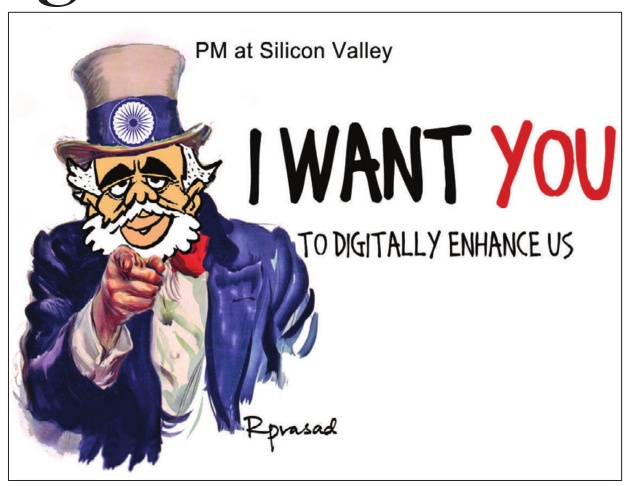
Here's how the cartoonists saw Narendra Modi's US visit

Prime Minister Narendra Modi is currently on the last leg of his six-day-long tour to the United States that has been creating quite a buzz. Apart from taking forward India’s bid for the coveted United Nations Security Council permanent membership, Modi is out wooing tech giants and investors to support his Digital India initiatives. He has already checked out Facebook, Google and Tesla Motors off the list by visiting their respective headquarters and pitching his vision.

Even though the enthusiasm of the press in the US has been somewhat lukewarm this time, the media in India has been giving it saturation coverage, beaming his meetings and speeches live.

While editorials in newspapers are heaping praise on his vision and diplomacy while dissecting the potential outcome of the prime minister's visit, cartoonists have focussed on the concerns back home about internet access, privacy and net neutrality, which the Modi government itself is currently grappling with, and, of course, on noisy controversies such as the one caused by Modi's signature,  on the national flag which resulted in a social media outrage.

Here’s a roundup of some of the cartoons that appeared in major newspapers over the last few days:

The Economic Times  


The Hindustan Times


The Indian Express


The Hindustan Times


The Hindustan Times


Activists ask Mark Zuckerberg to wash his hands after meeting with Modi

Among the highest points of Prime Minister Narendra Modi's US tour was his meeting on Sunday with Facebook founder and CEO Mark Zuckerberg. At the end of the mutually congratulatory encounter, Modi wrote on the real wall at the Facebook headquarters. "Ahimsa is the greatest Dharma," declared the message, written in Gujarati.
Ironically, Modi's alleged refusal to adhere to the precept of Ahimsa, has motivated a group of activists called the Alliance for Justice and Accountability, to start a campaign called Zuck, Wash Your Hands! In response to the Modi-Zuckerberg meet, they aim to send hundreds of bottles of hand sanitiser to the Facebook founder to help wash the blood off his hands – reference to Modi's failure to halt religious riots that left nearly 1,000 people dead in Gujarat in 2002 when he was chief minister.
"The American public – and in particular, the leaders of Silicon Valley – must remember that Modi is not simply a prime minister making a trade visit, he is a man responsible for genocide," said a spokesperson for the collective.
The campaign invites people to fill out a form and have a bottle of sanitizer sent to Zuckerberg on their behalf. A total of 250 bottles have been sent out so far, the website reports. Each bottle bears the name of one of the victims of the 2002 Gujarat riots.
Modi's message at Facebook would almost seem to be a response to allegations against his complicity in the riots. Modi frequently invoked Gandhi's legacy of non-violence on his tours abroad. He has so far unveiled Mahatma Gandhi busts in Australia, Germany, Kyrgyzstan, Turkmenistan, and a Centre for Gandhian studies in China.

Modi in US: Emphatic posturing on climate change

India’s Intended Nationally Determined Contributions (INDCs), to be unveiled on Mahatma Gandhi’s birthday on October 2 for added moral dimension, are keenly awaited across world capitals after Prime Minister Narendra Modi pointedly apprised leading western nations, notably the United States, France and Britain, of the third world’s need for access to finance and technology for clean energy to combat climate change without hurting their development. By making developmental priorities non-negotiable, Modi put the onus of the success of the Paris summit (Nov 30-Dec 11, 2015) on the developed world.

Climate change is real. Earthquakes, floods, hurricanes, melting ice caps, polluted air and water are taking a severe toll on human and animal life. The vagaries of the weather afflict agriculture, putting food security at risk. The warning bells have tolled unheeded for over three decades, but now global warming, ozone depletion, and rising sea levels threaten the very existence of several small island nations from the Pacific to the Atlantic. Of special concern are the Pacific Island countries that helped Indian scientists to track the movement of the iconic Mars mission, a point Modi pointedly made in his speech at the UN Sustainable Development Summit in New York, where he demanded “climate justice” and urged acceptance of “common but differentiated responsibilities”.

It’s a huge challenge. At least $100 billion annually will be needed to help developing countries cope with and fight climate change; as world finance ministers meet in Lima, Peru (Oct. 7-8), it is uncertain if they can agree on that figure. Yet the man-made crisis is so serious that a further rise in temperatures must be kept below 2 degrees Celsius, or climate change will become irreversible.

Beijing, the greatest greenhouse gas emitter, made a deal with Washington two years ago to peak its emissions by 2030, before beginning reductions. Delhi may announce its peak emission target on October 2, but the government is adamant that combating poverty and giving over 300 million Indians access to energy has priority over reducing its carbon footprint. Modi’s hopes of accessing technology were raised when Microsoft founder Bill Gates joined his meeting with President Hollande.

Claiming that India is already implementing many of the Agenda 2030 goals adopted at the summit as these coincide with the philosophy of BJP ideologue, Deendayal Upadhyaya, who placed the welfare of the last man at the centre of his concerns, Modi urged cooperation in developing renewable sources of energy through innovation, finance and technology. He felt the developed world must make lifestyle changes to arrest environmental degradation through “sustainable consumption”, and was adamant that there would be no compromise with his election promises of housing, power, water and sanitation for all, which are critical for welfare, human dignity, and female empowerment.
India’s development agenda, Modi stressed, is compatible with the Sustainable Development Goals. It includes a financial inclusion scheme for poverty alleviation (Jan Dhan Yojana) under which 180 million new bank accounts have been opened; a nationwide skill development programme; direct transfer of benefits; funds to the unbanked; insurance for all; pension for all; smart cities projects; Swachh Bharat campaign in cities and villages; and plans to provide clean drinking water and 24×7 electricity. The ‘save the girl child’ and ‘educate her’ campaign has made powerful inroads across the country, while the prime minister’s advocacy of a “blue revolution” (fisheries) converges with anxieties regarding global warming and the danger to island states.Much of India’s new economic growth will come from individual enterprises supported by microfinances, start-ups and innovations, but India has to revive her manufacturing sector and make massive investments in infrastructure to realise the smart cities which are seen as sustainable engines of progress. India is also working to make farms more productive and better connected to markets, so farmers are less vulnerable to inclement weather.

Aware that his ambitions may trigger fears that India might be lax in reducing emissions, Modi reminded his audience that Indian culture regards the Earth as Mother, and pointed to his government’s stated ambitions to produce 175 GW of electricity through renewable energy sources in just seven years (by 2022), and undertake a host of energy efficiency measures, including a tax on coal; improving public transportation; using household waste to generate electricity; and a huge afforestation programme, especially along national highways.
Asserting that India’s developmental paradigm includes its development partners in Asia, Africa and the island states from the Pacific to the Atlantic, Modi cannily insisted that the developed world must fulfill its financing commitments for development and climate change, without clubbing the two under the same head! In a swipe at the hitherto unchallenged Patent Raj of the west, he hoped the Technology Facilitation Mechanism would turn technology and innovation into an instrument for global public good, not just private returns.